
 By Admin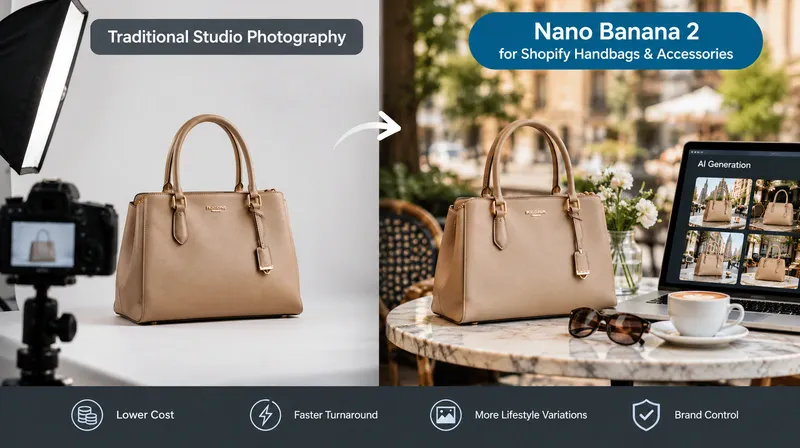
Scaling an e-commerce catalog for luxury handbags and accessories presents a relentless visual bottleneck. When a Shopify store prepares for a seasonal launch, the primary obstacle is rarely product design or inventory planning; it is the sheer friction of visual asset production. A single leather tote or structured crossbody bag requires multiple lifestyle contexts—an autumn city sidewalk, a sunlit cafe table, a sleek marble vanity, and an evening dinner setting—to convert high-intent shoppers across homepage banners, collection cards, and paid social ads. Adopting modern AI generation tools like nano banana 2 helps brands overcome this bottleneck by rapidly generating realistic settings.
Traditional commercial photography requires booking physical studios, hiring models, renting high-end props, shipping delicate samples, and enduring three to four weeks of post-production retouching. For fast-growing e-commerce brands, this traditional pipeline creates severe operational drag. As generative image models evolve from novel tech experiments into enterprise production assets, store owners are evaluating Google’s latest model, nano banana 2, against conventional optical studio workflows. Deciding between camera shoots and a nano banana 2 AI-assisted rendering workflow requires a clear analysis of material fidelity, unit economics, turnaround speed, and brand control.
The Commercial Context for Handbag Visual Production
The handbags and accessories category relies heavily on tactile consumer perception. Unlike basic apparel items that can be draped on dress forms, accessories must convey texture, weight, structure, and craftsmanship through high-resolution imagery.
Shoppers scrutinize the grain of pebbled leather, the crispness of edge-stitching, the reflective luster of polished brass hardware, and the natural drape of shoulder straps. When evaluating AI image generation with nano banana 2, a visual flaw or unnatural lighting setup directly compromises perceived product value and lowers conversion rates on Shopify product detail pages (PDPs).
Historically, achieving high perceived value left merchants with only one viable route: full-scale studio photography. A typical shoot for a collection of twenty handbag SKUs involves significant upfront investment:
- Studio & Equipment Hire: $1,500–$3,000 per day for specialized lighting grids, softboxes, and macro camera rigs.
- Creative Personnel: $2,500–$5,000 per day for commercial photographers, prop stylists, wardrobe assistants, and hand models.
- Sample Logistics & Risk: Shipping prototype handbags to external studios risks sample damage, lost inventory, and launch delays if customs or couriers fail.
- Post-Production Retouching: $25–$75 per image for color correction, shadow cleanup, and dust removal, extending lead times by several weeks.
When totaled, producing four lifestyle shots per SKU easily exceeds $20,000 per seasonal campaign, resulting in a unit cost of $150 to $300 per finalized asset. For high-growth digital brands expanding rapidly, this traditional model limits how many creative variations can be tested on Meta ads or localized for international markets. This financial and operational ceiling is precisely where AI models like Nano Banana 2 step in to replace expensive set builds while preserving core product identity through realistic Nano Banana 2 generation routines.
Modern visual operations platforms like seonb2—an enterprise visual integration layer for AI rendering models like Nano Banana 2—have emerged to bridge the gap between AI model capabilities and commercial e-commerce requirements, enabling creative teams using nano banana 2 to build standardized generation pipelines without sacrificing design control.
Core Evaluation Criteria for E-Commerce Visual Assets
To determine whether AI image synthesis via nano banana 2 can supplement or replace physical photography for handbags and accessories, e-commerce managers must assess performance across four objective benchmarks:
1. Surface Texture and Material Fidelity
Handbags feature diverse, complex materials including full-grain leather, suede, woven canvas, and metallic hardware. An acceptable visual workflow using Nano Banana 2 must accurately render light behavior on these surfaces—capturing the matte texture of suede alongside the sharp specular highlights on gold-plated zipper pulls.
2. Multi-Subject and Spatial Consistency
A major limitation of early generative AI models was spatial hallucination—warping bag straps, altering handle proportions, or adding extra buckles. Commercial generation models like nano banana 2 bring Pro-grade visual rendering and world knowledge down to high-speed execution, supporting strict multi-element consistency across multiple subjects and objects in a single frame.
3. Contextual and Environmental Adaptability
Lifestyle photos must place products in aspirational environments without letting background clutter distract from the item. The ideal nano banana 2 visual asset maintains pin-sharp focus on the product while rendering natural background bokeh, realistic cast shadows, and accurate environmental reflections.
4. Operational Velocity and Unit Economics
Production pipelines must match the fast pace of digital marketing. Marketers need the ability to generate, review, test, and swap lifestyle backgrounds within hours rather than waiting weeks for reshoots.
In benchmarking tests conducted on seonb2 workflows, visual teams evaluate generative pipelines not by artistic flair, but by their ability to consistently meet these commercial criteria across hundreds of SKU variations.
Trade-Off Analysis: Studio Shoots vs. Nano Banana 2
Choosing between traditional camera production and AI rendering requires weighing specific operational trade-offs rather than assuming one approach fits every scenario.
| Evaluation Dimension | Traditional Studio Photography | Nano Banana 2 Workflow |
| Unit Cost per Final Image | $150 – $300+ per asset | $0.05 – $0.20 per asset |
| Turnaround Time (Batch of 50) | 14 – 21 business days | 15 – 30 minutes |
| Optical Material Fidelity | Absolute 100% camera accuracy | 92% – 96% photo-real fidelity |
| Environmental Flexibility | Limited by physical set budget | Unlimited scene and lighting variations |
| Iterative Reshooting Cost | Requires full studio re-booking | Instant prompt modification or re-render |
| Multi-Language & Regional Customization | Extremely expensive per market | Automated background and text localization |
Traditional studio photography remains the gold standard for absolute optical precision. When photographing ultra-luxury leather goods for high-resolution print catalogs or macro zoom inspection on PDP hero slot, physical lenses capture microscopic grain details that generative tools like nano banana 2 may occasionally smooth over.
However, for the vast majority of e-commerce touchpoints—including homepage banners, category landing pages, seasonal promotional graphics, and paid advertising—adopting nano banana 2 allows merchants to eliminate traditional studio bottlenecks. Powered by a high-speed Flash architecture, nano banana 2 generates 2K and 4K images at a fraction of traditional costs while dramatically improving prompt adherence and text rendering for embedded brand elements, hangtags, or localized promotional signage.
By integrating seonb2 into the visual production chain, teams can feed clean studio product cutouts into the nano banana 2 rendering engine, preserving the exact physical bag structure while placing it across dozens of photorealistic lifestyle environments in seconds.
Scenario-Based Recommendations for Shopify Merchants
Rather than forcing a binary choice between studio shoots and AI generation, successful Shopify merchants adopt a hybrid production model based on specific asset roles:
Visual Asset Production Strategy
│
┌─────────────────────────────────┴─────────────────────────────────┐
▼ ▼
Primary PDP Hero Images Lifestyle Banners & Ad Creatives
(100% Structural Precision) (High-Volume Contextual Scenes)
│ │
▼ ▼
Traditional Studio Cutouts Nano Banana 2 Generation Pipeline
- Clean white background • Seasonal lifestyle scenes
- Studio lighting grid • Regional environment swaps
- Macro texture focus • Rapid ad variation testing
Scenario A: PDP Top-Carousel Anchors (Use Traditional Studio Photography)
For the main hero image on a Shopify product page—specifically the clean, white-background isolation shot—traditional optical photography remains recommended over Nano Banana 2 outputs. The primary image must serve as an undisputed visual reference for bag dimensions, zipper placement, and exact color matching.
Scenario B: Seasonal Lifestyle Campaigns (Use Nano Banana 2)
When launching seasonal campaigns (such as Summer Resort, Fall Fashion, or Holiday Gift Guides), relying entirely on physical location shoots is cost-prohibitive. Leveraging Nano Banana 2 to generate contextual backdrops around the studio-isolated product photo allows brands to produce hundreds of atmospheric lifestyle assets for a fraction of the cost.
Scenario C: Performance Marketing & Ad Creative Testing (Use AI Workflows)
Growth marketers need continuous ad creative refreshes to combat ad fatigue on TikTok and Meta. Generating lifestyle scenes with nano banana 2 enables performance teams to test different demographics, urban vs. rural settings, and color palettes daily, instantly scaling winning visual hooks.
Implementation Boundaries and Operational Safeguards
While modern AI image generation with nano banana 2 offers immense scale, publishing unvetted synthetic images directly to a Shopify storefront introduces operational risks. E-commerce teams must establish clear safeguards before deployment:
1. Strap and Hardware Distortion Audits
Generative models like nano banana 2 can occasionally warp thin straps or misalign metallic buckles. Every generated image must pass an internal review checking for structural symmetry, strap continuity, and correct hardware placement.
2. Color Calibration and Swatch Alignment
Lighting shifts in synthetic backgrounds can alter how product colors appear on calibrated screens. Brand managers must ensure that lighting adjustments in nano banana 2 do not alter true handbag hues, preventing customer returns caused by color mismatches.
3. Resolution and Compression Standards
Always export final assets in 2K or 4K resolution, using web-optimized image formats (WebP or AVIF) to maintain crisp visual presentation on Retina mobile screens without slowing down Shopify page load speeds.
4. Asset Provenance and Quality Tracking
Maintaining centralized digital asset management inside seonb2 helps maintain strict brand standards across internal teams, agency partners, and freelance designers, ensuring every published asset aligns with core brand identity.
+———————————————————————–+
| PRE-PUBLISHING QUALITY CONTROL CHECKLIST |
+———————————————————————–+
| [ ] 1. Product Geometry: Are handles, straps, and seams distortion-free?|
| [ ] 2. Material Authenticity: Does leather grain look natural? |
| [ ] 3. Color Accuracy: Does the rendered shade match physical swatches?|
| [ ] 4. Lighting Cohesion: Do product shadows match background light? |
| [ ] 5. Platform Optimization: Is the file exported in high-res WebP? |
+———————————————————————–+
By establishing clear operational boundaries and combining traditional studio cutouts with high-speed nano banana 2 scene generation, Shopify handbag and accessory brands can scale their visual catalog efficiently, reduce seasonal campaign costs, and maintain high conversion rates across all digital touchpoints. For more information, visit our website.
 admin
admin