
 By admin
The rapid evolution of the residential power landscape has moved beyond simple appliance management into the realm of complex system architecture. For the modern multi-EV household, the garage is no longer a storage space; it is a high-concurrency power hub. When two electric vehicles are integrated into a domestic grid—alongside legacy high-draw systems like HVAC units, server racks, and industrial-grade kitchen appliances—the challenge shifts from simple connectivity to sophisticated Load Balancing and System Redundancy.
In the world of technology, we understand that a system is only as stable as its weakest link. In a home electrical environment, that link is often the main breaker panel. To manage the massive current demands of simultaneous EV charging without triggering a “cascading system failure,” homeowners must move away from “analog” charging and embrace Intelligent Power Infrastructure.
The Architecture of Power: Understanding the Amperage Bottleneck
Every residential electrical system operates within a defined bandwidth, typically a 100A or 200A main service. Integrating even a single high-speed EV charger adds a significant “persistent thread” to the system’s total load. According to the National Electrical Code (NEC), EV charging is classified as a “continuous load,” meaning it must be calculated at 125% of its operating amperage for safety protocols.
- 32A Configuration: Consumes 40A of system bandwidth.
- 40A Configuration: Consumes 50A of system bandwidth.
- 50A Configuration: Consumes 60A of system bandwidth.
In a dual-EV ecosystem, the “Concurrency Challenge” is clear: running two 50A chargers simultaneously at peak power would demand 120A of dedicated capacity. On a 200A panel, this leaves less than 40% of remaining bandwidth for the entire rest of the house. For geeks who understand system optimization, the solution isn’t just “more power”—it is smarter allocation through the EVDANCE Wall-Mounted Collection.
Software-Defined Power: The EVDANCE Digital Console
What separates a “dumb” charger from a professional-grade Energy Hub is the level of granular control over the electrical flow. The EVDANCE Smart App acts as a digital management console, allowing for “Software-Defined Current Limiting.”
- One-Slide Current Regulation Through the EVDANCE UI, users can engage in real-time “Amperage Throttling.” Much like adjusting the CPU priority of a background process, the “One-Slide Control” allows you to manually scale the output from 16A to 50A. This is critical in a dual-EV scenario. If one vehicle requires a rapid top-off while the other only needs a maintenance charge, the user can dynamically shift the “power bandwidth” without ever touching the hardware. This prevents the main breaker from reaching its thermal trip point during periods of high household concurrency.
- Real-Time Telemetry & Energy Logging Data is the foundation of optimization. The EVDANCE ecosystem provides high-frequency sampling of critical system metrics: Voltage (V), Amperage (A), and Internal Temperature (T). For the technical user, the App’s “Detailed Charging Data” isn’t just a status update; it is a Telemetry Log. By analyzing the Visual Charts, users can perform a “Energy Audit,” tracking efficiency losses and monitoring the stability of the local grid. If the voltage drops significantly under a 50A load, the EVDANCE system provides the visual evidence needed to diagnose utility-side resistance or internal wiring bottlenecks.
Engineering Redundancy: Why 50A Hardwired is the Logical Standard
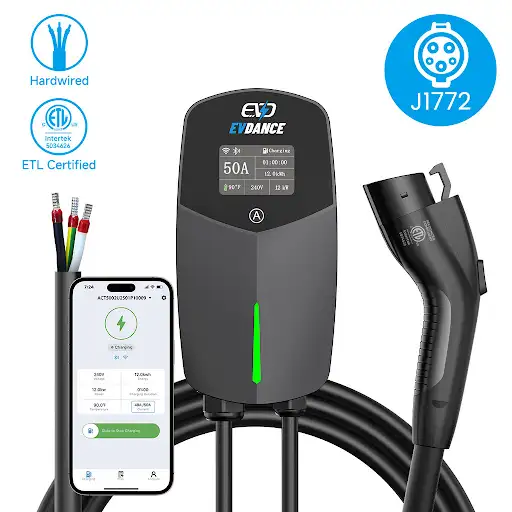
In any mission-critical system, hardware redundancy and physical integrity are paramount. For the 50A/12kW tier, EVDANCE utilizes a Hardwired Infrastructure model rather than a plug-and-socket interface.
From a physics perspective, every mechanical connection (like a NEMA 14-50 plug) introduces a point of “Thermal Resistance Fluctuation.” Over thousands of hours of high-current flow, these mechanical contacts can degrade, leading to increased impedance and heat buildup. By opting for a 50A Hardwired EVDANCE station, you create a permanent, low-impedance copper-to-terminal bond. This “Ruggedized” design ensures that the 12kW flow remains stable even in extreme environmental conditions, effectively future-proofing the garage for the next generation of high-capacity EV battery architectures.
Case Studies in Load Management Architecture
To understand how to deploy EVDANCE hardware effectively, let’s look at three common system configurations:
Scenario A: The Legacy 100A Panel (Efficiency Mode) In homes with limited service, the EVDANCE 32A Wall-Mount is the logical choice. By setting a hard limit via the app, the charger ensures it never exceeds the system’s “headroom,” allowing the user to charge safely while the home’s HVAC and lighting systems operate concurrently.
Scenario B: The 200A Dual-EV Setup (Tiered Allocation) For a household with a 200A panel and two vehicles, the optimal architecture often involves a “Tiered Configuration.” By installing one 50A EVDANCE Hub for primary fast-charging and one 40A unit for secondary tasks, the homeowner can utilize the App’s “Scheduling” feature to stagger the start times. This prevents a simultaneous “cold-start” surge on the main breaker while ensuring both vehicles are at 100% SoC by morning.
Scenario C: High-Heat Environments (Thermal Protection) In regions where garage temperatures can exceed 100°F, charging at 50A presents a thermal challenge. EVDANCE’s internal smart chipsets monitor temperatures in real-time (e.g., maintaining a constant 90.0°F as shown in our telemetry logs). If the system detects a thermal anomaly, the App allows for a proactive “down-clocking” of the amperage to protect the home’s wiring.
Environmental Resilience: IP66 as a System Shield
For geeks who appreciate “Hardened” electronics, the EVDANCE series’ IP66 rating is a critical spec. While most consumer-grade chargers settle for IP54 (splash-proof), IP66 signifies a “Hermetically Protected” logic board. This prevents micro-dust and humidity from causing logic errors or short-circuits in the smart controller, ensuring the “digital brain” of your power hub remains functional for a 10+ year lifecycle.
Conclusion: Don’t Let Your Home Grid be a Black Box
In 2026, home energy is no longer a utility you simply “consume”; it is a system you must manage. By choosing the EVDANCE Wall-Mounted series, you are moving away from “dumb” analog charging and adopting a scalable, transparent, and intelligent power architecture. Whether you are managing the concurrency of a dual-EV household or optimizing for maximum ROI via smart scheduling, EVDANCE provides the telemetry and hardware redundancy required for a modern high-tech lifestyle.
Explore the EVDANCE Flux Pro Engineering Specs: EV Charging Station – EVDANCE
Configure your home’s energy architecture at the EVDANCE Official Site: Shop Portable EV Chargers & EV Extension cord at EVDANCE
Take control of your household amperage and future-proof your digital grid with EVDANCE.
For more informative articles, visit our site daily.
 Admin
Admin