
 By admin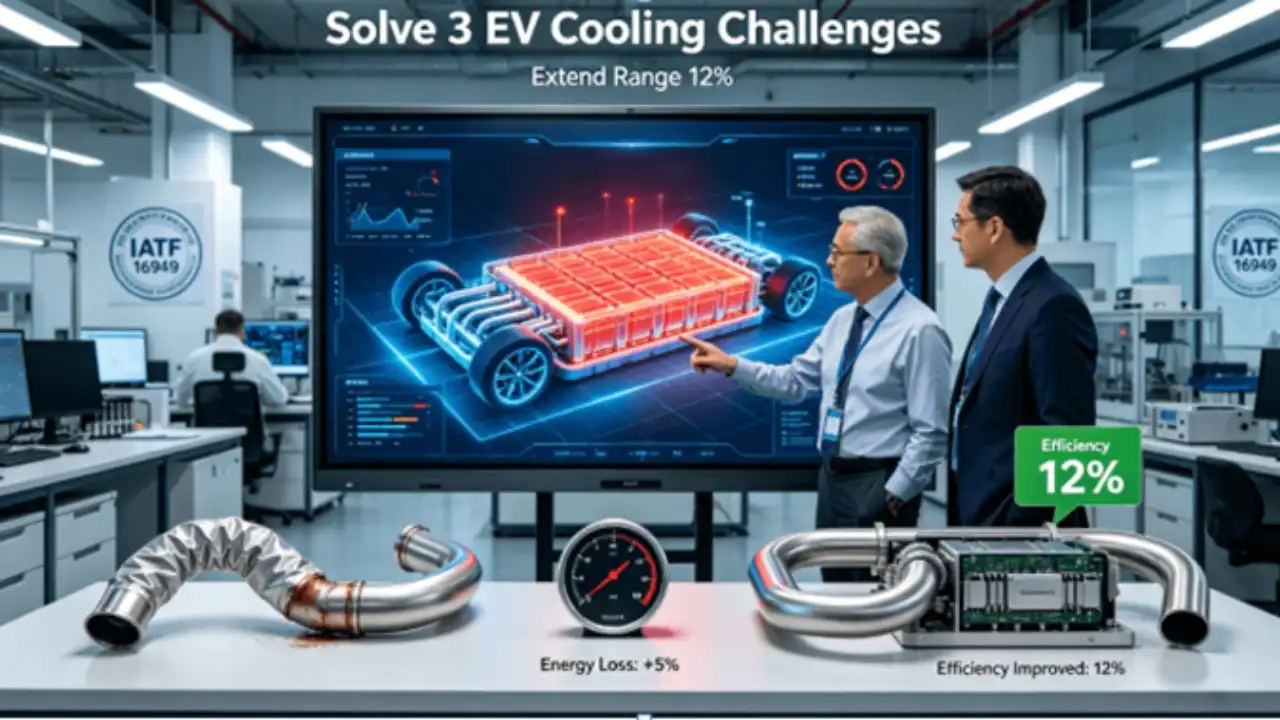
The race towards vehicle electrification is forcing a critical reevaluation of every component. Manufacturing engineers face a core dilemma: how to drastically reduce vehicle weight to extend range while ensuring the complex battery, power electronics, and motor thermal management systems are leak-proof, efficient, and reliable. Traditional tube fabrication often becomes a bottleneck, forcing compromises on weight, precision, or design freedom that can lead to leaks, energy losses, and performance penalties.
These challenges stem from a failure to systematically integrate materials science, fluid dynamics, and advanced forming processes. Off-the-shelf tube solutions cannot meet the compact, custom layouts required for optimal thermal control, turning the fluid pathway into a performance bottleneck. This article details how precision tube bending serves as a key enabling technology. By examining three specific thermal management scenarios, it reveals how high-tolerance forming, optimized design, and process control work in concert to directly boost efficiency and reliability. To understand this synergy, we must start at the intersection of material and design.
How Does Advanced Tube Bending Enable the “Lightweighting vs. Strength” Paradox in Modern Vehicle Design?
This section explores the core paradox of lightweighting, explaining how precision bending of advanced materials allows for significant mass reduction without sacrificing the structural integrity and pressure rating essential for safety and performance.
1. Leveraging High-Strength Alloys Through Controlled Forming
Design optimization for tube bending begins with material selection. Engineers increasingly turn to high-strength, lightweight alloys like 6061-T6 aluminum or 304 stainless steel. However, these materials present forming challenges like springback and work hardening. Precision tube bending processes use CNC-controlled tooling with real-time feedback to accurately compensate for springback, ensuring the final bent angle matches the design intent. This precise control prevents the creation of weak points from over- or under-bending, which is critical for maintaining the burst pressure rating of lightweight vehicle components. Selecting the right alloy and adhering to its forming limits, as defined by standards from organizations like SAE International, is foundational to achieving reliable lightweight structures.
2. Engineering Geometry for Maximum Efficiency and Minimal Mass
True optimization extends beyond material choice to the geometry itself. Precision tube bending services utilize simulation software to predict wall thinning and ovality during the bend. This allows engineers to design the tightest possible bend radius for a given wall thickness without risking collapse, minimizing the overall envelope and weight of the fluid system. This capability enables the creation of compact, space-saving routing for high-efficiency exhaust systems and coolant loops, directly contributing to overall vehicle packaging and weight savings. The goal is to use the minimal material necessary to meet all functional requirements, a principle at the heart of sustainable design.
3. Validating Performance Through Predictive Analysis and Testing
The virtual validation loop is essential. Advanced bending simulations not only predict form but also analyze stress distribution post-forming. This ensures the bent tube can withstand thermal cycles, vibration, and pressure pulsations. The final validation comes through physical testing, such as pressure cycling and burst tests, confirming that the lightweighted component meets or exceeds all durability specifications. This data-driven approach from design to validation transforms the bending process from a simple shaping operation into a critical engineering step for performance and safety.
What Are the Critical Tube Bending Tolerances Required for Leak-Free EV Battery Cooling Loops?
This segment focuses on the most demanding application: EV battery cooling loops. It details the stringent tolerances for angle, position, and form that are non-negotiable for creating a sealed, reliable system that prevents catastrophic failure.
1. The High Cost of Geometric Deviation in Sealed Systems: In EV thermal management systems, a microscopic leak is a critical failure. Tolerances that might be acceptable in a structural frame are disastrous here. High tolerance tube bending must control bend angles within ±0.5 degrees and the positional accuracy between tube ends within ±0.25 mm. Any error accumulates across multiple bends, leading to misalignment at connection points like cold plates or manifolds. This misalignment forces O-rings or gaskets to seal outside their design envelope, creating a path for slow leaks or, worse, immediate assembly failure under pressure testing.
2. The Critical Role of Ovality Control in Fluid Dynamics: Beyond angle and position, controlling the tube’s cross-sectional shape is paramount. Excessive ovality (a deviation from a perfect circle) reduces the effective flow area, increasing flow resistance and reducing cooling efficiency. More critically, an oval tube profile prevents uniform sealing force around the entire circumference of a fitting. Precision tube bending processes, especially mandrel bending, are designed to maintain roundness, typically keeping ovality under 3% of the tube diameter. This ensures consistent contact for seals and optimal fluid flow for heat exchange.
3. Implementing a System of Digital and Physical Verification: Achieving this level of consistency requires a closed-loop system. Controlling the geometric dimensioning and tolerancing (GD&T) of bent tubes, in alignment with standards like ASME Y14.5, is non-negotiable for ensuring leak-proof interfaces. Modern quality assurance uses 3D scanning for First Article Inspection (FAI), creating a full color-map deviation report against the CAD model. For production, Statistical Process Control (SPC) monitors key bending parameters in real-time, ensuring the process capability (Cpk) remains high. This end-to-end control is what defines true precision tube bending services and delivers the reliability & consistency metrics demanded by the automotive industry.
Can Optimized Bend Sequences and Mandrel Techniques Reduce Pressure Drop in Complex Fluid Systems?
This section examines how the bending process itself impacts system performance. It explains how poor technique increases flow resistance and pump energy consumption, while optimized methods preserve efficiency.
1. The Hydraulic Impact of Internal Tube Deformation
Every bend in a fluid system introduces a pressure drop. Poorly executed bends exacerbate this through internal deformation. Without proper support, the inner radius of a bend can wrinkle or corrugate, while the outer wall thins and may collapse. These imperfections create turbulence, disrupting laminar flow and significantly increasing the system’s pumping power requirement. For precision fluid systems like battery chillers or motor oil coolers, minimizing this parasitic loss directly translates to extended vehicle range and higher overall system efficiency.
2. The Mandrel’s Role in Preserving Flow Path Integrity
Manufacturing process optimization for bending centers on technique selection. For tight radii or thin-walled tubes, mandrel bending is essential. A multi-segmented, lubricated mandrel rod is inserted into the tube during bending. It supports the inner wall from collapsing, while the bending die and pressure die work from the outside. This combination ensures a smooth, consistent interior surface and a round cross-section throughout the bend. The result is a predictable, low-loss flow path that computational fluid dynamics (CFD) analyses can model with high accuracy.
3. Strategic Planning for Multi-Bend Assemblies
The sequence of bends in a complex part also affects the final outcome. An optimal bend sequence minimizes material handling, reduces the chance of tooling interference on subsequent bends, and helps maintain consistent dimensional relationships between features. Advanced custom tube bending services use simulation software to plan the optimal sequence before any metal is formed. Furthermore, for components that integrate flanges, ports, or special connection features, combining high-precision bending with tube laser cutting services in a single setup ensures the highest contour accuracy and consistency for the entire assembly.
How Do Sustainable Manufacturing Principles Apply to the Tube Bending Process Itself?
This part extends sustainability from product function to the manufacturing process. It analyzes how precision bending reduces waste, material use, and energy consumption, aligning production with ecological goals.
1. Minimizing Material Waste Through First-Time-Right Precision
A core tenet of sustainable manufacturing processes is waste reduction. Traditional cut-and-try methods generate significant scrap from misshapen or out-of-tolerance parts. Precision CNC tube bending, guided by accurate digital models and simulations, achieves a “first-time-right” outcome with extremely high consistency. This drastically reduces scrap rates. Furthermore, digital nesting software optimizes the use of raw tube lengths, minimizing off-cuts. This efficient use of material, especially expensive alloys, lowers the environmental footprint and raw material cost.
2. Reducing Energy Consumption Across the Production Lifecycle
Sustainability also encompasses energy efficiency. A precision bending process that produces dimensionally accurate, leak-free parts eliminates the energy-intensive rework, welding, or reforging often required to fix faulty components. The finished, efficient fluid system itself — enabled by precision bends — operates with lower pump energy over the vehicle’s lifetime. Adopting waste-minimizing and energy-efficient practices aligns with broader environmental stewardship goals, as highlighted by resources from the Environmental Protection Agency (EPA) on sustainable manufacturing.
3. Enabling Durable and Serviceable System Designs
Precision-bent tubes contribute to product longevity and repairability, key aspects of a circular economy. Systems designed with precisely located bends and interfaces are easier to assemble and disassemble without damage. This facilitates maintenance, repair, and eventual recycling. By enabling the creation of robust, long-lasting clean technology components, precision bending supports a product lifecycle that minimizes total resource consumption and waste generation, moving beyond a narrow focus on the production moment.
From Prototype to Production: What Quality Gates Ensure Reliability in Mission-Critical Applications?
This section outlines the multi-layered quality assurance system required to scale from a validated prototype to reliable mass production, highlighting the role of certifications as embedded systems.
1. Prototype Validation: Bridging Digital and Physical Worlds
The journey begins with rigorous prototype validation. The first article produced undergoes a comprehensive 3D scan, comparing every bend angle, plane, and length to the digital master. This First Article Inspection Report (FAIR) is the foundation. For fluid systems, 100% of prototype parts typically undergo pressure decay or flow testing to validate performance. This stage confirms not just form, but function, ensuring the design intent is fully realized before production tooling is finalized.
2. Statistical Process Control for Production Consistency
Scaling up introduces variability. High tolerance tube bending in production is governed by Statistical Process Control. Key parameters — like bend angle, pressure die assist force, and mandrel position — are monitored in real-time. Data is plotted on control charts to calculate Process Capability Indices (Cpk). A Cpk of 1.67 or higher for critical features indicates a process that is not only within specification limits but is also centered and stable, guaranteeing reliability & consistency metrics across thousands of parts.
3. Certifications as a Framework for Systemic Assurance
Quality management system certifications like IATF 16949 (automotive) and AS9100D (aerospace) are not just certificates on a wall. They represent an audited, systemic framework that mandates these very controls — Advanced Product Quality Planning (APQP), Control Plans, and Failure Mode and Effects Analysis (FMEA). This systemic approach ensures that every step, from material certification to final audit, is controlled. Therefore, selecting a partner for critical applications requires evaluating their end-to-end capability, including synergistic processes like custom laser cutting service, to ensure all manufacturing stages operate under the same high standard.
Beyond Unit Price: How to Calculate the True Cost of Compromise in Tube Bending Tolerances?
This final analysis shifts the focus from piece-part cost to Total Cost of Ownership (TCO). It provides a model for quantifying how upfront investment in precision avoids downstream failures and inefficiencies.
- Quantifying the Hidden Costs of Assembly and Warranty: A marginally cheaper, less precise tube bend carries a high hidden cost. Dimensional inconsistency forces fitters to use shims, extra force, or corrective bending during assembly, increasing labor time and the risk of damaging other components. In the field, a leak caused by a poor seal due to ovality can lead to catastrophic system failure, costly recalls, and warranty claims. For operators managing fleet maintenance solutions, the cost of a single roadside breakdown or unscheduled maintenance event can eclipse the savings from thousands of “cheaper” tubes.
- The Efficiency Tax of Poor Hydraulic Performance: The financial impact extends to operational efficiency. A cooling loop with internally deformed tubes or misaligned connections suffers higher flow resistance. This forces the coolant pump to work harder, drawing more electrical power from the battery. Over the lifecycle of an electric vehicle or industrial machine, this constant “efficiency tax” in extra energy consumption can amount to a significant operational cost, directly eroding the value proposition of the clean technology components.
- A Holistic View of Value in Custom Fabrication: A comprehensive TCO analysis must factor in design flexibility, time-to-market, and supply chain simplicity. Custom metal bending services that offer design optimization for tube bending expertise can often consolidate multiple parts into a single, optimized tube, eliminating assembly steps, seals, and potential leak points. This upfront collaboration may have a higher engineering cost but results in a simpler, more reliable, and ultimately less expensive total system. The true value lies in viewing the tube not as a commodity, but as a performance-critical subsystem where precision manufacturing is an investment, not a cost.
Conclusion
In the realms of clean technology and electrification, precision tube bending has evolved from a simple forming operation into a critical engineering discipline that directly impacts product performance, efficiency, and sustainability. By systematically solving the intertwined challenges of lightweighting, thermal management, fluid efficiency, and manufacturing ecology, it empowers the competitiveness of the end product. The strategic application of high-tolerance forming, coupled with design-for-manufacturability and rigorous process control, transforms a basic conduit into a high-performance system enabler.
FAQs
Q1: What is the typical tolerance achievable with precision CNC tube bending for high-pressure fluid systems?
A: For critical systems like EV battery cooling, high-precision CNC tube bending can consistently achieve bend angle tolerances of ±0.5 degrees and positional tolerances within ±0.25 mm. Maintaining roundness (ovality) within 3% of the tube diameter is also crucial to prevent flow restriction and ensure proper sealing. These results require advanced machinery with real-time feedback and meticulous process control.
Q2: How does material choice (like aluminum vs. stainless steel) impact the bending process and design for lightweight systems?
A: Aluminum offers excellent weight savings and thermal conductivity but is softer, requiring specialized tooling to manage springback and surface finish. Stainless steel provides superior strength but needs greater bending force and careful management of work hardening. The choice dictates the minimum bend radius, tooling strategy, and need for annealing, directly impacting design feasibility and cost.
Q3: What are “mandrel bends” and when are they necessary compared to standard press bending?
A: Mandrel bending involves inserting a flexible rod inside the tube during bending to support the inner wall. This is essential for preventing wrinkles or collapse when bending thin-walled tubes, tight radii, or expensive materials. Standard press bending is suitable for thicker walls and larger radii but carries a higher risk of internal deformation, impacting hydraulic performance.
Q4: Can bent tubes be effectively joined to laser-cut manifolds or connectors, and what are the key considerations?
A: Yes, this is a common practice. Success hinges on accounting for cumulative tolerances from both processes. Key considerations include specifying mating surfaces with appropriate GD&T, designing self-locating features, and potentially using adaptive welding techniques. A supplier with integrated tube bending and laser cutting capabilities best manages these tolerances holistically.
Q5: What documentation should I expect from a precision tube bending supplier for automotive or aerospace qualification?
A: Beyond material certifications, expect a detailed First Article Inspection Report (FAIR) with 3D scan data, full dimensional results, and bend data reports. Process documentation like Control Plans and PFMEAs, along with evidence of Statistical Process Control (SPC) for key characteristics, is vital. Certifications like IATF 16949 or AS9100D assure that these quality systems are formally in place and audited.
Author Bio
The insights in this article are contributed by a senior engineering team with over a decade of expertise at the intersection of precision manufacturing and clean technology application. Their specialized knowledge is applied to deliver manufacturing solutions for global clients that meet the most stringent industry standards for performance and reliability. If you are facing tube forming challenges in the development of next-generation EV thermal management systems or other clean technology components, the engineering team at LS Manufacturing can provide a complimentary Design for Manufacturability (DFM) analysis. Submit your preliminary design today for a professional assessment.