
 By admin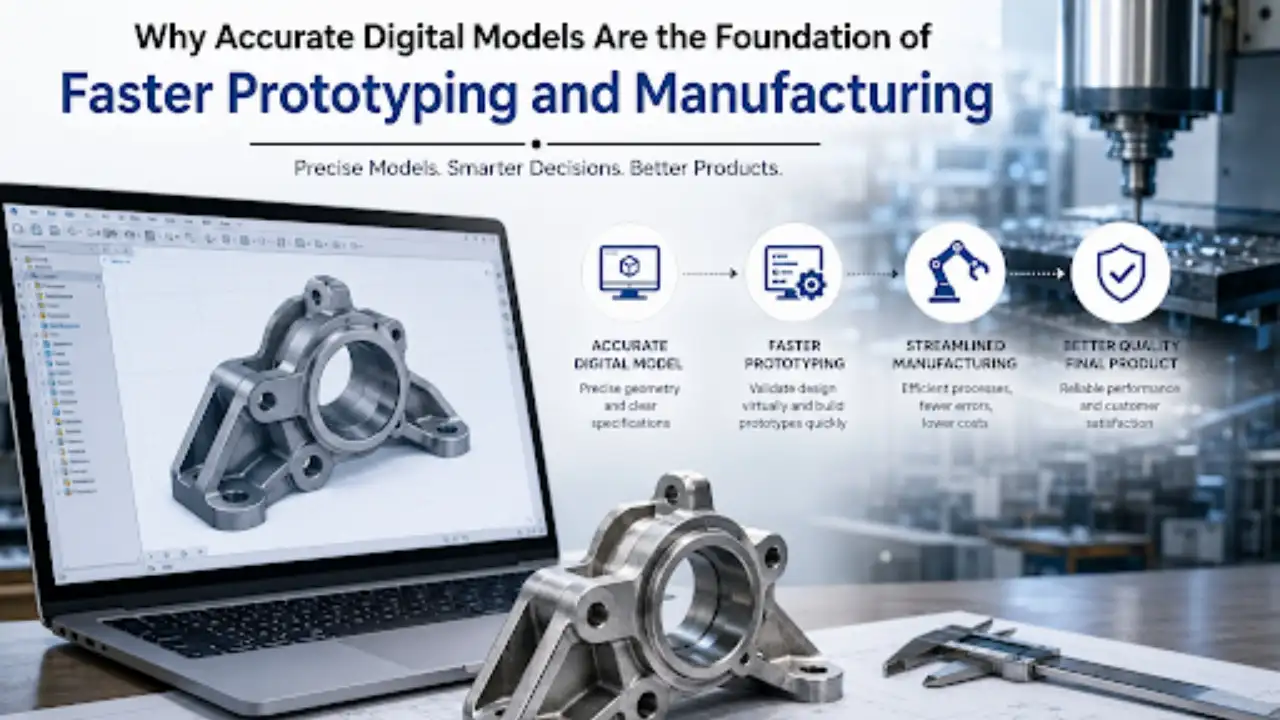
roduct development has become a race against time. Whether it’s a startup bringing a new consumer gadget to market or an established manufacturer designing industrial equipment, the pressure is the same: reduce development cycles, control costs, and deliver high-quality products faster than competitors.
The challenge is that manufacturing is unforgiving. Every design flaw that escapes into production becomes exponentially more expensive to fix. A hole that’s misplaced by 0.5 mm on a CAD model may seem insignificant, but once it propagates through tooling, machining, assembly, and quality inspection, it can lead to scrapped parts, delayed shipments, and thousands of dollars in rework.
This is exactly why businesses increasingly invest in professional 3d cad modeling services. A precise digital model is no longer just a visualization tool—it serves as the engineering blueprint that drives prototyping, simulation, manufacturing, inspection, and even product lifecycle management. When the digital model is accurate, every downstream process becomes faster, more predictable, and significantly less expensive.
In many ways, a CAD model functions like source code in software engineering. If the codebase is clean, modular, and logically structured, development accelerates. If it’s poorly written, every new feature introduces bugs. Likewise, manufacturing inherits the quality of the digital model. Precision at the design stage creates efficiency throughout production.
Why Digital Models Matter Before Manufacturing Begins
Manufacturing no longer starts on the factory floor—it begins inside engineering software.
Modern CAD platforms enable engineers to define every geometric feature, dimensional tolerance, material property, and assembly relationship long before any material is cut. This virtual representation becomes the authoritative dataset shared across design, engineering, procurement, manufacturing, and quality assurance teams.
Instead of asking “Will this design work?”, organizations can answer the question digitally before investing in tooling or production.
Eliminating Costly Design Errors Early
One of the biggest advantages of accurate CAD modeling is identifying problems while they are still inexpensive to solve.
Consider a housing designed for an electric motor. If the mounting holes are offset by even a fraction of a millimeter, the error may not be noticed until physical assembly. At that stage, correcting the mistake might require:
- redesigning machined components
- updating manufacturing drawings
- modifying CNC programs
- rebuilding fixtures
- delaying production schedules
By contrast, detecting the issue inside the CAD environment requires only minutes of engineering work.
According to the classic engineering cost curve, design changes become exponentially more expensive as a product progresses from concept to manufacturing. Correcting a feature during modeling may cost a few engineering hours, whereas correcting the same issue after production begins could cost thousands in materials, labor, and downtime.
Improving Collaboration Between Design and Manufacturing Teams
Modern manufacturing involves multiple disciplines working simultaneously.
Mechanical engineers develop the product geometry.
Manufacturing engineers evaluate machining strategies.
Industrial designers refine aesthetics.
Quality engineers define inspection criteria.
Procurement teams source components.
Without an accurate digital model, each department operates using different assumptions.
CAD models solve this problem by acting as a common engineering language. Everyone references the same geometry, dimensions, assemblies, and revision history.
This dramatically reduces communication errors while improving cross-functional collaboration.
Creating a Single Source of Truth for Product Development
Today’s digital manufacturing ecosystem extends far beyond CAD software.
A single 3D model may feed:
- Finite Element Analysis (FEA)
- Computational Fluid Dynamics (CFD)
- CNC programming (CAM)
- Mold design
- Robotic toolpaths
- Coordinate Measuring Machine (CMM) inspection
- Product Lifecycle Management (PLM)
- Enterprise Resource Planning (ERP)
Rather than recreating geometry at every stage, downstream systems consume the original engineering model.
This “single source of truth” minimizes inconsistencies while ensuring every department works from identical product data.
How Accurate CAD Models Speed Up Prototyping
Rapid prototyping is often misunderstood as simply “printing parts faster.”
In reality, speed comes from eliminating unnecessary iterations.
Every prototype exists to answer engineering questions:
- Does the mechanism move correctly?
- Will components interfere?
- Is the structure strong enough?
- Can technicians assemble it?
- Does the product meet ergonomic requirements?
Accurate CAD models answer many of these questions before the first prototype is built.
Faster Design Iterations
Digital models allow engineers to modify geometry parametrically.
Instead of rebuilding an entire component, they adjust dimensions, constraints, or design features.
For example, increasing the wall thickness from 2.5 mm to 3 mm automatically updates related features, assembly clearances, and engineering drawings.
This dramatically shortens revision cycles compared to manual drafting methods.
The result is a continuous engineering feedback loop rather than isolated design phases.
Better Compatibility with 3D Printing and CNC Machining
Different manufacturing technologies have different design constraints.
A model optimized for injection molding may not be ideal for CNC machining.
Similarly, additive manufacturing introduces considerations like:
- overhang angles
- support structures
- layer orientation
- internal lattice structures
Professional CAD modeling ensures geometry respects manufacturing constraints before production begins.
This reduces failed prints, machining collisions, and unnecessary setup changes.
The National Institute of Standards and Technology (NIST) has highlighted how accurate digital models and digital twins improve manufacturing reliability and quality assurance by creating consistent data throughout the production lifecycle.
Virtual Testing Before Physical Production
Physical testing remains essential, but digital simulation allows engineers to eliminate weak concepts much earlier.
Instead of manufacturing five prototype iterations, engineers may digitally evaluate dozens.
Common simulations include:
- structural stress analysis
- fatigue analysis
- thermal expansion
- airflow behavior
- vibration response
- motion analysis
This engineering-first approach dramatically shortens prototype cycles.
Rather than discovering failures after fabrication, engineers identify them during simulation.
The Business Benefits of Professional 3D CAD Modeling Services
While CAD software is widely available, creating production-ready engineering models requires specialized expertise.
Professional CAD modeling focuses not only on geometry but also manufacturability, tolerancing, assembly relationships, and downstream compatibility.
Reduced Manufacturing Costs
Manufacturing costs are driven by mistakes far more than material prices.
Accurate CAD models reduce:
- scrap rates
- tooling revisions
- assembly issues
- machining errors
- inspection failures
- engineering change orders
Each avoided mistake contributes directly to improved profitability.
Shorter Product Development Cycles
Time-to-market often determines commercial success.
When engineering teams spend less time correcting preventable design issues, products move through development more efficiently.
Accurate models accelerate:
- design reviews
- stakeholder approvals
- supplier communication
- manufacturing planning
- prototype fabrication
Instead of reacting to problems, organizations proactively prevent them.
Improved Product Quality and Consistency
Manufacturing consistency begins with dimensional consistency.
Every machined feature, molded surface, or printed layer originates from the CAD model.
When geometry is mathematically precise, downstream processes produce more predictable results.
Consistent digital data leads to consistent physical products.
Easier Design Changes Without Restarting the Process
Engineering changes are inevitable.
Customer feedback.
New regulations.
Supplier changes.
Material shortages.
Performance improvements.
With well-structured CAD models, these revisions become manageable instead of disruptive.
Parametric modeling allows modifications to propagate automatically throughout assemblies and documentation, reducing redesign effort.
Industries That Depend on Precision CAD Modeling
Virtually every manufacturing sector depends on high-quality digital models, but the importance becomes even greater in highly regulated or precision-driven industries.
Automotive
Automotive manufacturers manage assemblies containing thousands of components.
Accurate CAD models ensure:
- proper clearances
- assembly sequencing
- manufacturability
- crash simulation
- supplier integration
Even small dimensional inaccuracies can affect vehicle performance and production efficiency.
Aerospace
Aerospace components operate under extreme environmental conditions while maintaining exceptionally tight tolerances.
CAD accuracy supports:
- lightweight structural optimization
- finite element analysis
- aerodynamic development
- certification documentation
- precision machining
Errors measured in fractions of a millimeter can compromise safety and certification.
Medical Devices
Medical products must satisfy stringent regulatory standards while maintaining exceptional reliability.
Precise CAD models support:
- implant design
- surgical instruments
- patient-specific devices
- sterilization considerations
- manufacturing validation
Digital accuracy directly contributes to patient safety.
Consumer Products
Whether designing smart home devices or wearable electronics, manufacturers rely on CAD models to optimize:
- appearance
- ergonomics
- assembly
- packaging
- production efficiency
Rapid iteration allows brands to respond quickly to changing consumer expectations.
Industrial Equipment
Heavy machinery often involves complex assemblies, welded structures, hydraulic systems, and custom components.
Accurate CAD models reduce installation conflicts while simplifying maintenance planning and future upgrades.
Common Mistakes Businesses Make with Digital Models
Even organizations that use CAD software sometimes undermine manufacturing efficiency by relying on poor modeling practices.
Using Low-Quality CAD Files
Models created solely for visualization often lack manufacturing-grade precision.
Problems include:
- missing tolerances
- incomplete feature definitions
- broken surfaces
- non-manifold geometry
- poor assembly constraints
These issues create unnecessary work during production.
Ignoring Manufacturing Constraints
An elegant design isn’t necessarily manufacturable.
Sharp internal corners, inaccessible toolpaths, unrealistic wall thicknesses, or impossible draft angles may require extensive redesign.
Design for Manufacturability (DFM) should be considered from the earliest modeling stages.
Poor Version Control
Manufacturing teams occasionally receive outdated CAD files while engineering works from newer revisions.
Without disciplined revision management, incorrect parts may enter production.
Modern Product Lifecycle Management (PLM) systems help eliminate this risk by maintaining controlled engineering revisions.
Designing Without Production Feedback
Engineering and manufacturing should operate as a continuous feedback loop.
Machine operators, quality inspectors, and assembly technicians often identify opportunities for improving designs.
Incorporating this feedback into CAD models creates progressively better products over successive development cycles.
Choosing the Right 3D CAD Modeling Partner
Not every CAD provider produces manufacturing-ready engineering models.
When evaluating a partner, businesses should consider more than software proficiency.
Look for expertise in:
- Design for Manufacturability (DFM)
- Geometric Dimensioning and Tolerancing (GD&T)
- Parametric CAD modeling
- Reverse engineering
- Assembly design
- Manufacturing documentation
- Revision management
- Rapid turnaround
- Cross-industry engineering experience
The ideal partner understands not only how to model geometry but also how that geometry behaves throughout machining, molding, assembly, inspection, and production.
Final Thoughts
Digital transformation in manufacturing isn’t simply about replacing paper drawings with 3D graphics. It’s about creating a reliable engineering foundation that supports every downstream decision.
An accurate CAD model acts as the digital thread connecting concept design, engineering analysis, prototyping, manufacturing, quality inspection, and future product improvements. Every dimension, feature, tolerance, and assembly relationship established during modeling influences the efficiency and accuracy of the entire production process.
Organizations that invest in high-quality 3d cad modeling services gain more than detailed digital drawings—they build products with fewer revisions, faster prototype cycles, lower manufacturing costs, and greater confidence that the final product will perform as intended.
As manufacturing continues to embrace automation, digital twins, AI-assisted engineering, and smart factories, the importance of accurate digital models will only grow. Companies that prioritize precision at the modeling stage will be better positioned to innovate quickly, reduce operational risk, and bring high-quality products to market ahead of the competition.